


 buy artwork
 buy artwork
Pi Day 2023 — Repeated Sequence — A modular synthesizer experience














On March 14th celebrate `\pi` Day. Hug `\pi`—find a way to do it.
For those who favour `\tau=2\pi` will have to postpone celebrations until July 26th. That's what you get for thinking that `\pi` is wrong. I sympathize with this position and have `\tau` day art too!
If you're not into details, you may opt to party on July 22nd, which is `\pi` approximation day (`\pi` ≈ 22/7). It's 20% more accurate that the official `\pi` day!
Finally, if you believe that `\pi = 3`, you should read why `\pi` is not equal to 3.

People find these numbers inconceivable — and I do too. Best thing to do is just relax and enjoy it. —Richard Feynman
Welcome to 2023 Pi Day: a celebration of `\pi` and mathematics, electronic music and cables. A lot of cables.



contents
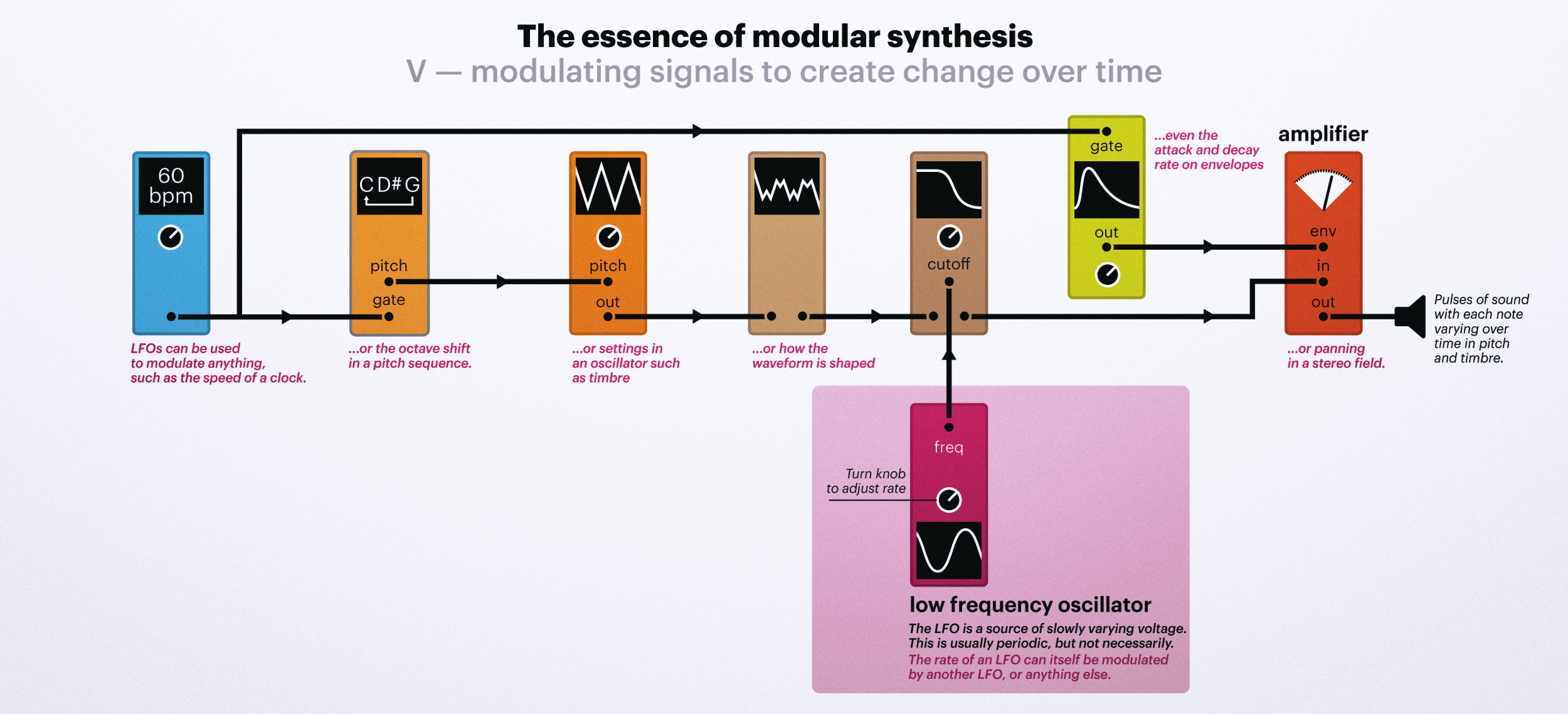
This piece was created with a modular synthesizer system, which you can see in the video. Look for the closeups to meet some of the key modules in the patch, such as Vector Space and the Triple Sloths.
You've probably seen at least one synthesizer — most have a keyboard, which allow you to select a note, and they all have a bunch of knobs, which allow you to shape the sound giving you wide control over what a note will sound like. This latter process is broadly known as sound design.
If you were to open up such a synthesizer, you'd see a bunch of different circuits hooked up to the knobs, with each circuit having a specific role in the signal flow. This is a simplification, but it's good enough.
In a modular synthesizer, those individual circuits are broken up into modules that you purchase separately. Each module has its own function — everything from making a sound to filtering to mixing and more. It's probably best to call such a setup a modular system since it can veritably act as multiple synthesizers, each composed of a group of modules.
The modules themselves come in a wide variety of designs and sizes. Some modules are very narrow and some are very wide, though the height of the module is fixed within a given modular standards. For example, Eurorack modules are 5.25" in height (3U, 1U = 1.75") whereas the Buchla/Serge system uses 4U (7") and Moog modular synth modules are 8.75" tall. There are even some short 1.75" (1U) modules in the Eurorack world.
The Triple Sloth is chaos circuit module. It output is the solution to a system of differential equations, similar to the Lorentz System.
There are three sloths, called Torpor, Inertia and Apathy. These have periods of about 20 seconds (Torpor), 2 minutes (Apathy) and 20 minutes (Inertia). You can see the realtime output of the Inertia slot at this point in the video.
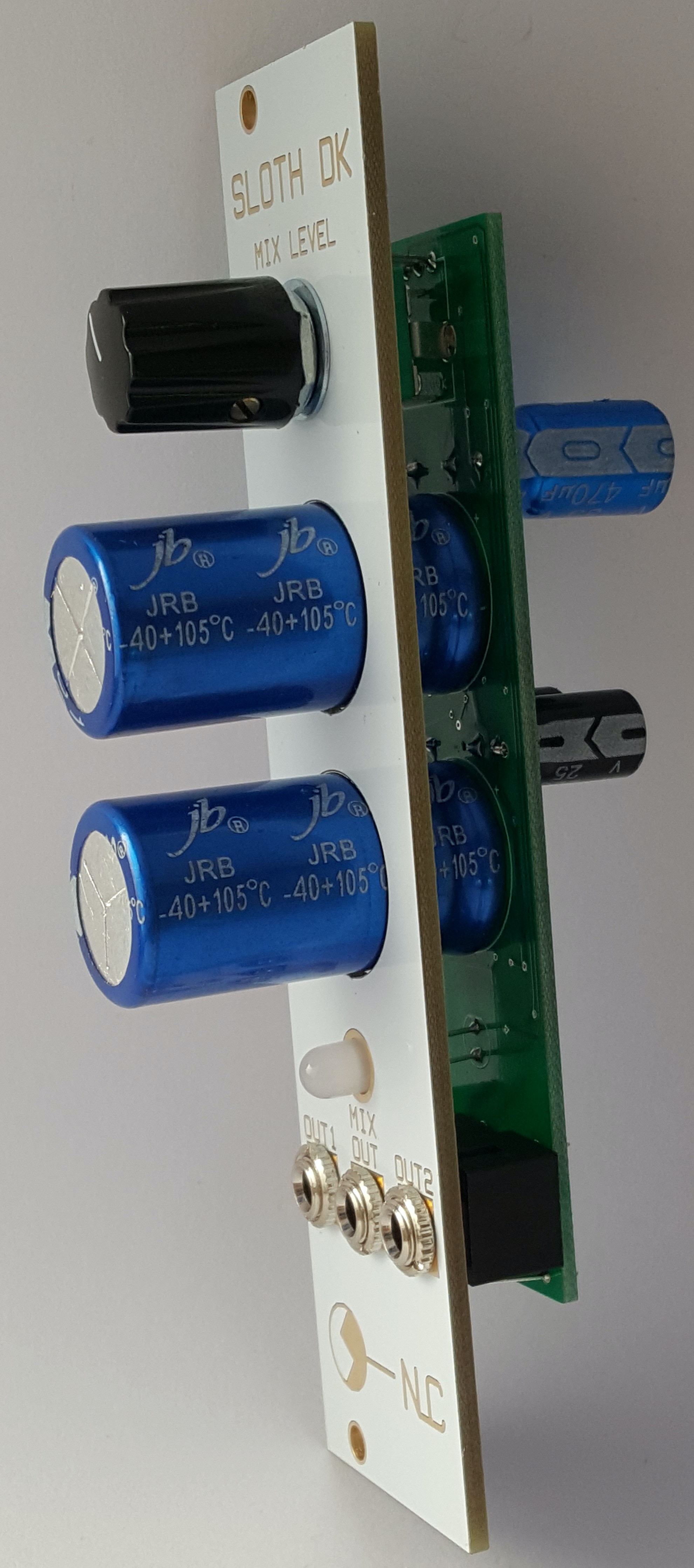
There's also a much slower sloth — Sloth DX — with a 20 hour period. This Sloth DX has capacitors that are so large that they stick out from the front of the module. As far as I know, this is the only module that exposes is internal components in this way.
This is a much longer version of the original 1 hour Repeated Sequence, which only went to the Feynman Point (769 digits).
In the 10 hour version we go to 10,000 digits. Up to the Feynman Point, this longer version is identical to the 1 hour version. After this point, though, it just keeps going — we let the modular patch play itself. During this time, we switch reels on the Morphagene to Esther and Anja giggling. There's mumbling too.
Starting at 8,000 digits, we ramp up the rack to a finale at 10,000 digits and then ramp down the rack for an outro. The last ~1,500 digits are read out at 4 digits per second in about 6 min 15 seconds.
If you'd like to learn the basics of modular synthesis, check out the Methods section.









Propensity score weighting
It is not certain that everything is uncertain. —Blaise Pascal
We have already explored how we can mitigate bias caused by confounding variables in observational studies using propensity score (PS) matching (PSM) and propensity score weighting (PSW). However, any statistical model is only as good as its assumptions and, if it is specified incorrectly, it can itself produce biased estimates of the treatment effect.
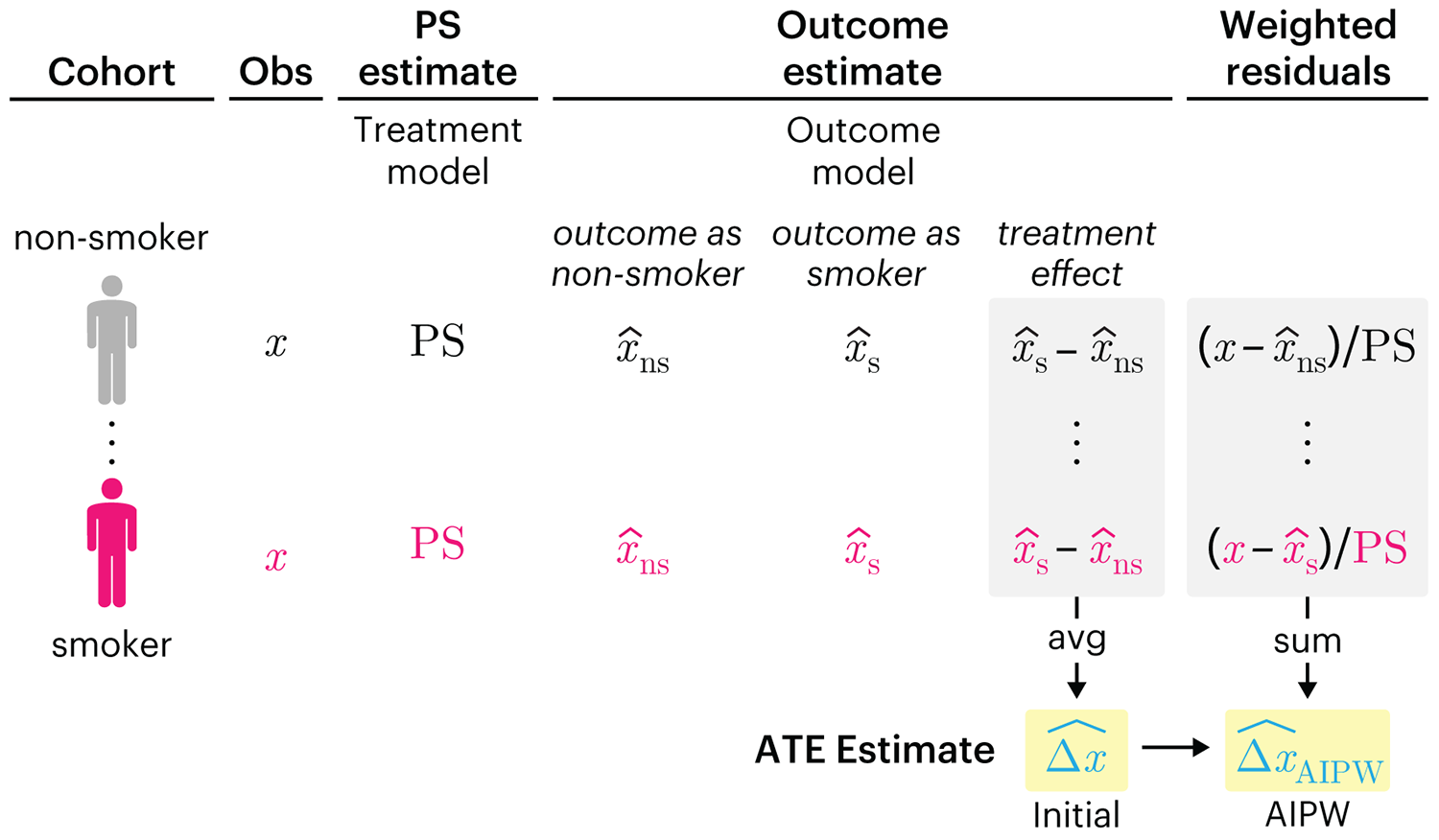
This month, we explore double robustness, a powerful statistical concept that provides a valuable “safety net” against the risk of an incorrect model. It offers two opportunities, instead of just one, to obtain a valid estimate of the treatment effect — making it possible to draw credible causal inferences from observational data without having to depend on a single set of modeling assumptions.
Kurz, C.F., Krzywinski, M. & Altman, N. (2026) Points of significance: Double Robustness. Nat. Methods 23:868–869.
Nature Biotechnology cover
My cover design on the 7 April 2026 Nature Biotechnology issue shows the dendrogram that represents a cluster of uniquely expressed (or downregulated) genes in human naive stem cells induced from such cells. Within each dendrogram block, the genomic barcode sequence (sampled from Supplementary Table 1) is depicted with a Code 39 barcode. The highlighted barcode is one of those used for cell isolation.
Ishiguro S. et al. A multi-kingdom genetic barcoding system for precise clone isolation (2026) Nature Biotechnology 44:616–629.

Browse my gallery of cover designs.

Happy 2026 π Day—
Art for the 5%
Celebrate π Day (March 14th) and enjoy the art — but only if you're part of the 5%.
Go ahead, see what you can't see.
Ishihara's Tests for Colour Deficiency
Authentic and accurate images of Ishihara's test plates photographed (and lovingly color-corrected) from the 38-plate Ishihara's Tests for Colour Deficiency.
I also provide the position, size, and color of each circle on each test plate.


Symmetric alternatives to the ordinary least squares regression
What immortal hand or eye, could frame thy fearful symmetry? — William Blake, "The Tyger"
This month, we look at symmetric regression, which, unlike simple linear regression, it is reversible — remaining unaltered when the variables are swapped.
Simple linear regression can summarize the linear relationship between two variables `X` and `Y` — for example, when `Y` is considered the response (dependent) and `X` the predictor (independent) variable.
However, there are times when we are not interested (or able) to distinguish between dependent and independent variables — either because they have the same importance or the same role. This is where symmetric regression can help.

Luca Greco, George Luta, Martin Krzywinski & Naomi Altman (2025) Points of significance: Symmetric alternatives to the ordinary least squares regression. Nat. Methods 22:1610–1612.
Beyond Belief Campaign BRCA Art
Fuelled by philanthropy, findings into the workings of BRCA1 and BRCA2 genes have led to groundbreaking research and lifesaving innovations to care for families facing cancer.
This set of 100 one-of-a-kind prints explore the structure of these genes. Each artwork is unique — if you put them all together, you get the full sequence of the BRCA1 and BRCA2 proteins.
