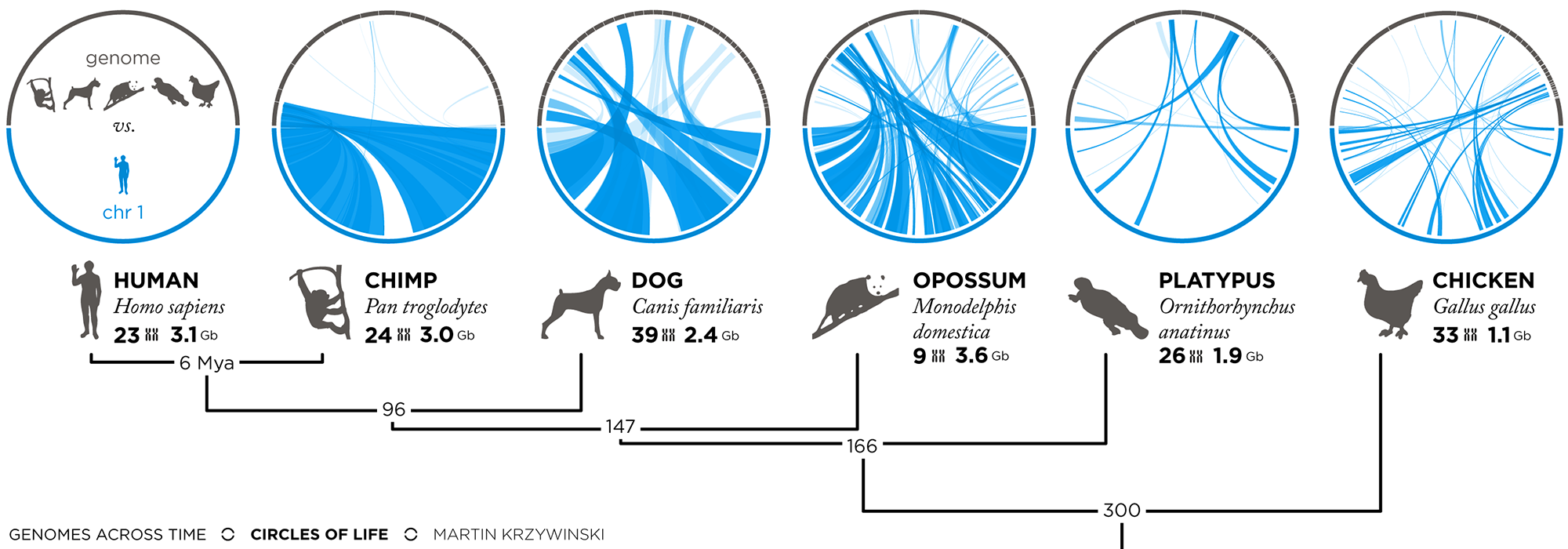
Comparison of the human genome to the genomes of chimp, dog, opossum, platypus, and chicken.
design: Martin Krzywinski




Access all columns for free at Statistics for Biologists Nature Collection.
The Points of Significance column was launched in September 2013 as an educational resource to authors and to provide practical suggestions about best practices in statistical analysis and reporting.
This month we launch a new column "Points of Significance" devoted to statistics, a topic of profound importance for biological research, but one that often doesn’t receive the attention it deserves.
The "aura of exactitude" that often surrounds statistics is one of the main notions that the Points of Significance column will attempt to dispel, while providing useful pointers on using and evaluating statistical measures.
—Dan Evanko, Let's Give Statistics the Attention it Deserves in Biological Research
The column is co-authored with Naomi Altman (Pennsylvania State University). Paul Blainey (Broad) is a contributing co-author.
In February 2015, Nature Methods announced that the entire Points of Significance collection will be free.
When Nature Methods launched the Points of Significance column over a year ago we were hopeful that those biologists with a limited background in statistics, or who just needed a refresher, would find it accessible and useful for helping them improve the statistical rigor of their research. We have since received comments from researchers and educators in fields ranging from biology to meteorology who say they read the column regularly and use it in their courses. Hearing that the column has had a wider impact than we anticipated has been very encouraging and we hope the column continues for quite some time.
—Dan Evanko, Points of Significance now free access
Also, in a recent post on the ofschemesandmemes blog, a new statistics collection for biologists was announced.
The pieces range from comments, to advice on very specific experimental approaches, to the entire collection of the Points of Significance columns that address basic concepts in statistics in an experimental biology context. These columns, originally published in Nature Methods thanks to Martin Krzywinski and guest editor Naomi Altman, have already proven very popular with readers and teachers. Finally, the collection presents a web tool to create box plots among other resources.
—Veronique Kiermer, Statistics for biologists—A free Nature Collection
Each column is written with continuity and consistency in mind. Our goal is to never rely on concepts that we have not previously discussed. We do not assume previous statistical knowledge—only basic math. Concepts are illustrated using practical examples that embody the ideas without extraneous complicated details. All of the figures are designed with the same approach—as simple and self-contained as possible.
Either I've been missing something or nothing has been going on. —Karen Elizabeth Gordon
Missing data are everywhere. Subjects may decline to participate in a survey or fail to answer sensitive questions. A cell culture might fail due to contamination. Instrument failures or mishandling of a sample may lead to missing observations. But why are missing data a problem?
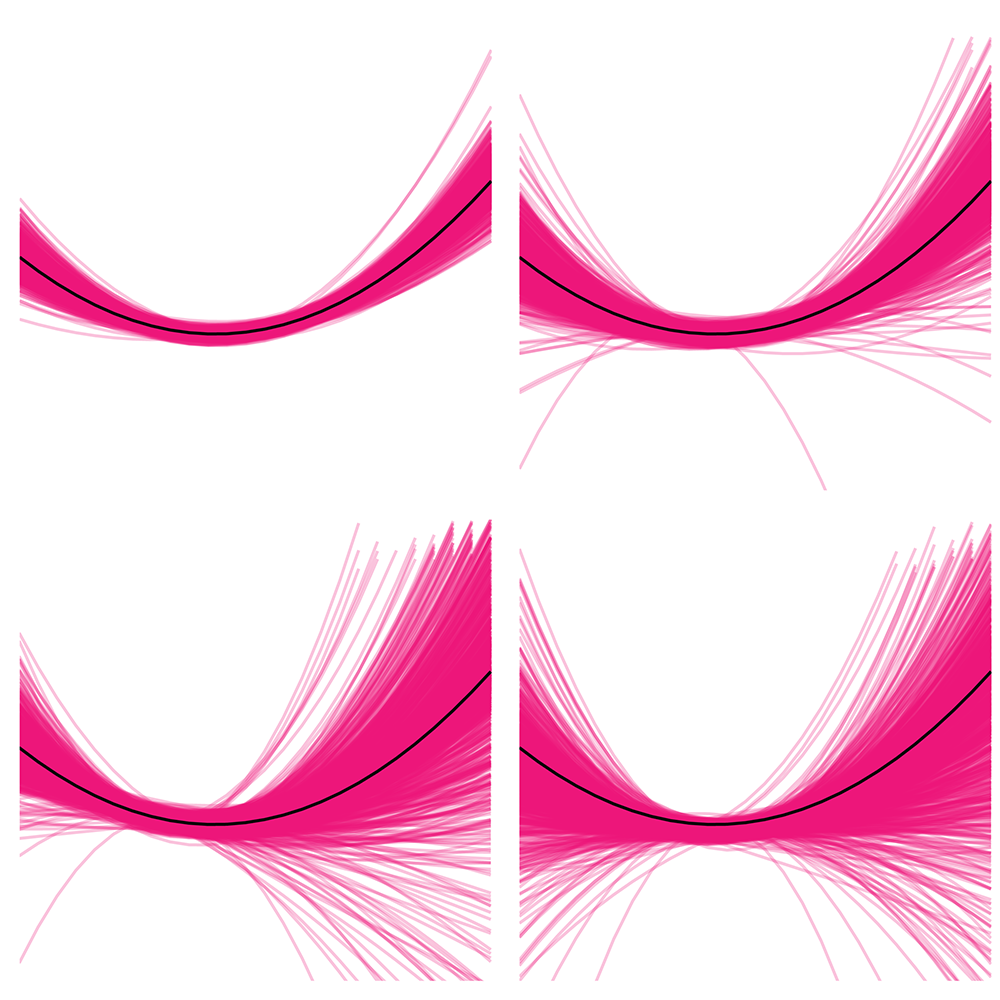
This month, we begin a series of articles about practical and statistical aspects of missing data. We'll see that missing data can increase variability and introduce bias and we will ask whether anything can be done to mitigate these consequences. It turns out that, in the case where we know nothing about the missing subjects, no mitigation is possible. We must accept higher variability and, if we have a suspicion that the missing subjects aren’t completely random, possible bias as well.
Tanujit Dey, T., Lipsitz, S.R., Fitzmaurice, G., Krzywinski, M. & Altman, N. (2026) Points of significance: Consequences of missing data. Nat. Methods 23:1661–1663.
It is not certain that everything is uncertain. —Blaise Pascal
We have already explored how we can mitigate bias caused by confounding variables in observational studies using propensity score (PS) matching (PSM) and propensity score weighting (PSW). However, any statistical model is only as good as its assumptions and, if it is specified incorrectly, it can itself produce biased estimates of the treatment effect.
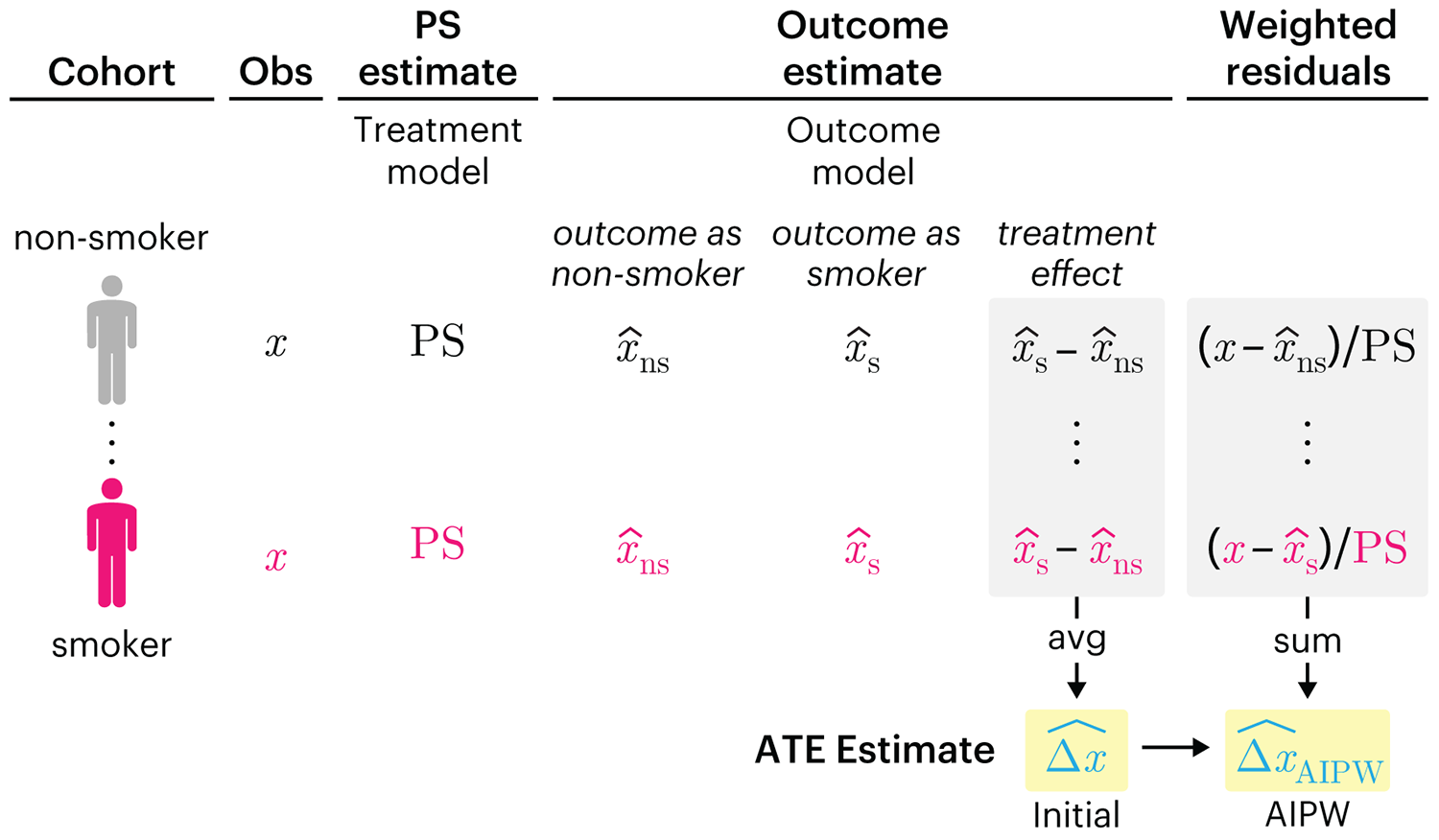
This month, we explore double robustness, a powerful statistical concept that provides a valuable “safety net” against the risk of an incorrect model. It offers two opportunities, instead of just one, to obtain a valid estimate of the treatment effect — making it possible to draw credible causal inferences from observational data without having to depend on a single set of modeling assumptions.
Kurz, C.F., Krzywinski, M. & Altman, N. (2026) Points of significance: Double Robustness. Nat. Methods 23:868–869.
My cover design on the 7 April 2026 Nature Biotechnology issue shows the dendrogram that represents a cluster of uniquely expressed (or downregulated) genes in human naive stem cells induced from such cells. Within each dendrogram block, the genomic barcode sequence (sampled from Supplementary Table 1) is depicted with a Code 39 barcode. The highlighted barcode is one of those used for cell isolation.
Ishiguro S. et al. A multi-kingdom genetic barcoding system for precise clone isolation (2026) Nature Biotechnology 44:616–629.

Browse my gallery of cover designs.

Celebrate π Day (March 14th) and enjoy the art — but only if you're part of the 5%.
Go ahead, see what you can't see.