2026 π Day latest news buy art
Drive, driven. Gave, given.YelloGive me a number of games.more quotes
very clickable
data visualization + art
The Personal OncoGenomics Program (POG) is a research initiative to study the impact of embedding genomic sequencing into real-time treatment planning for BC patients with metastatic cancers. Based out of the BC Cancer Research Centre and the GSC, POG is a large world-class clinical research collaboration of BC Cancer oncologists, pathologists and other clinical staff, researchers and technical personnel throughout BC healthcare facilities.
Interested in more art based on the POG570 cohort from the Personal OncoGenomics Program? Check out our 5-year POG anniversary posters and desktops.

Science Magazine cover — Human Genome Special Issue

The issue explores lessons from past studies of human genomics, with an eye toward future research efforts | 24 September 2021 | Volume 373 | Issue 6562

data sources
1. Amberger JS, Bocchini CA, Schiettecatte FJM, Scott AF, Hamosh A. OMIM.org: Online Mendelian Inheritance in Man (OMIM®), an online catalog of human genes and genetic disorders. Nucleic Acids Research 43:D789–98 (2015).
2. Pleasance E, Titmuss E, Williamson L et al. (2020) Pan-cancer analysis of advanced patient tumors reveals interactions between therapy and genomic landscapes. Nature Cancer 1:452–468.

Here, you can read about the method behind the design and download images to bring the cover to your wall or desktop.

Martin Krzywinski / Martin Krzywinski @MKrzywinski mkweb.bcgsc.ca
Human genome: chromosomes, genes and mutations. Visualization of the human genome as a spiral (scale: 1 million bases per centimeter), with colored segments representing different chromosomes. Circle size denotes the number of genes associated with Mendelian disorders and hollow circles indicate the number of mutation clusters from a pan-cancer analysis. Science (cover) | vol 373 | issue 6562 | 24 September 2021.

design elements

Each element is described in more detail in the methods section.

Martin Krzywinski / Martin Krzywinski @MKrzywinski mkweb.bcgsc.ca
The genome is arranged in an (almost) Archimedean spiral.
Martin Krzywinski / Martin Krzywinski @MKrzywinski mkweb.bcgsc.ca
Chromosomes are coded by maximally colors.

Martin Krzywinski / Martin Krzywinski @MKrzywinski mkweb.bcgsc.ca
Cytogenetic bands are colored by conventional grey tones used to depict Giemsa staining
Martin Krzywinski / Martin Krzywinski @MKrzywinski mkweb.bcgsc.ca
Bands are superimposed on chromosomes at 30% opacity

Martin Krzywinski / Martin Krzywinski @MKrzywinski mkweb.bcgsc.ca
Genes associated with Mendelian disorders are drawn as solid circles, whose size depicts the number of such genes in 250 kb bins
Martin Krzywinski / Martin Krzywinski @MKrzywinski mkweb.bcgsc.ca
Clusters of mutations from a pan-cancer analysis are shown as hollow circles, whose size depicts the number of clusters in 250 kb bins.

news + thoughts

Propensity score weighting

Mon 04-05-2026

It is not certain that everything is uncertain. —Blaise Pascal

We have already explored how we can mitigate bias caused by confounding variables in observational studies using propensity score (PS) matching (PSM) and propensity score weighting (PSW). However, any statistical model is only as good as its assumptions and, if it is specified incorrectly, it can itself produce biased estimates of the treatment effect.
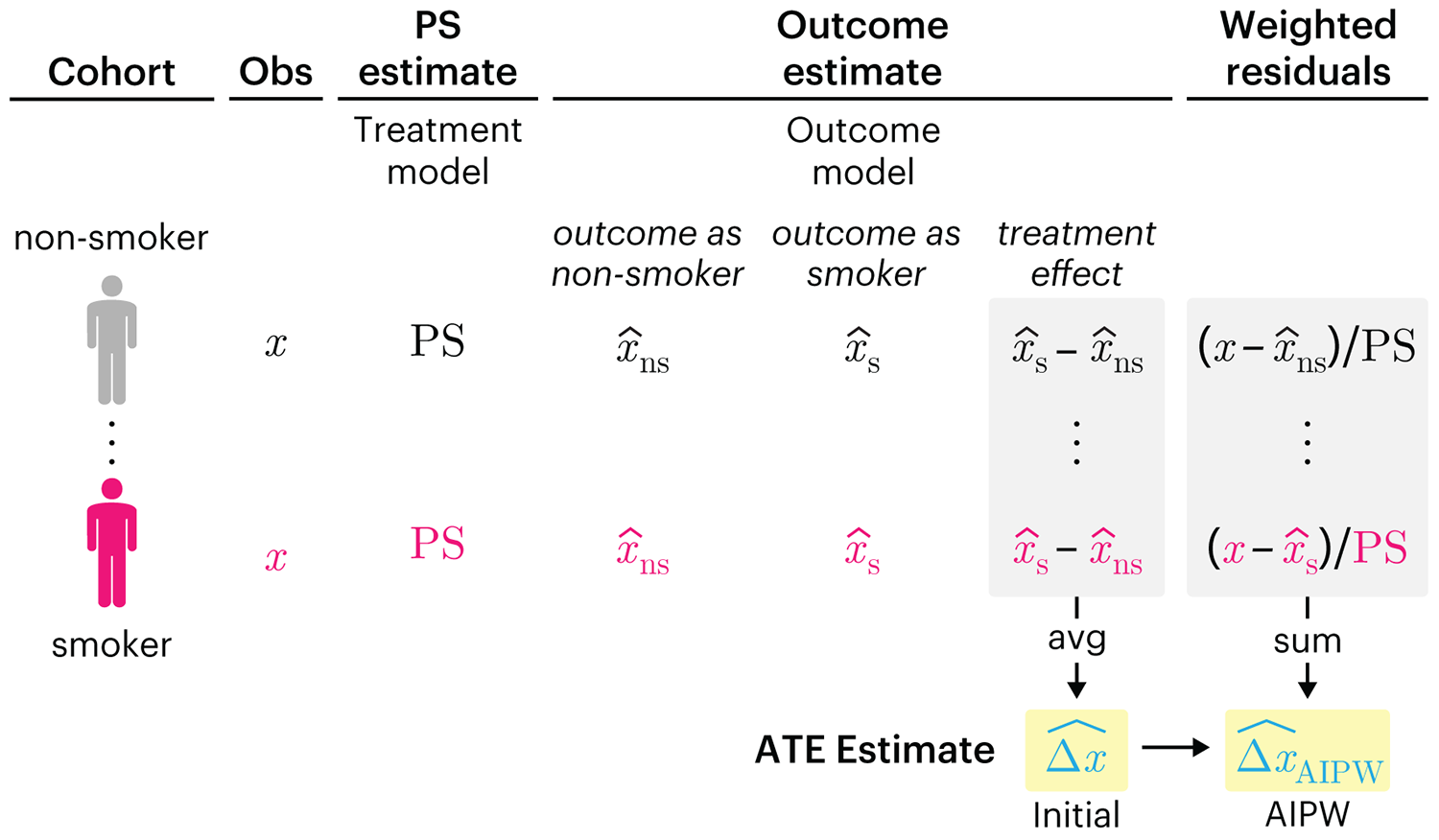
Martin Krzywinski @MKrzywinski mkweb.bcgsc.ca
Nature Methods Points of Significance column: Double Robustness. (read)

This month, we explore double robustness, a powerful statistical concept that provides a valuable “safety net” against the risk of an incorrect model. It offers two opportunities, instead of just one, to obtain a valid estimate of the treatment effect — making it possible to draw credible causal inferences from observational data without having to depend on a single set of modeling assumptions.

Kurz, C.F., Krzywinski, M. & Altman, N. (2026) Points of significance: Double Robustness. Nat. Methods 23:868–869.

Nature Biotechnology cover

Thu 23-04-2026

My cover design on the 7 April 2026 Nature Biotechnology issue shows the dendrogram that represents a cluster of uniquely expressed (or downregulated) genes in human naive stem cells induced from such cells. Within each dendrogram block, the genomic barcode sequence (sampled from Supplementary Table 1) is depicted with a Code 39 barcode. The highlighted barcode is one of those used for cell isolation.

Ishiguro S. et al. A multi-kingdom genetic barcoding system for precise clone isolation (2026) Nature Biotechnology 44:616–629.

Martin Krzywinski @MKrzywinski mkweb.bcgsc.ca
My Nature Biotechnology phylogenetic tree cover (volume 44, issue 4, 7 April 2026). (more)

Browse my gallery of cover designs.

Martin Krzywinski @MKrzywinski mkweb.bcgsc.ca
A catalogue of my journal and magazine cover designs. (more)

Happy 2026 π Day—
Art for the 5%

Fri 13-03-2026

Celebrate π Day (March 14th) and enjoy the art — but only if you're part of the 5%.

Go ahead, see what you can't see.

Martin Krzywinski @MKrzywinski mkweb.bcgsc.ca
2026 π DAY | Art for the 5%. Shown in the style of Ishihara color test plates, the art is visible only to those with colour blindness. (details)

Ishihara's Tests for Colour Deficiency

Sun 08-03-2026

Authentic and accurate images of Ishihara's test plates photographed (and lovingly color-corrected) from the 38-plate Ishihara's Tests for Colour Deficiency.

I also provide the position, size, and color of each circle on each test plate.

Martin Krzywinski @MKrzywinski mkweb.bcgsc.ca
ISHIHARA'S TEST PLATE 6 | This plate is part of the set of transformation plates. If you see 5, you're ok. If you see 2, you're not. (details)
Martin Krzywinski @MKrzywinski mkweb.bcgsc.ca
ISHIHARA'S TEST PLATE 18 | This plate is part of the set of mysterious hidden plates. If you don't see anything, you're ok. If you see 5, you're not. (details)

Symmetric alternatives to the ordinary least squares regression

Wed 23-07-2025

What immortal hand or eye, could frame thy fearful symmetry? — William Blake, "The Tyger"

This month, we look at symmetric regression, which, unlike simple linear regression, it is reversible — remaining unaltered when the variables are swapped.

Simple linear regression can summarize the linear relationship between two variables `X` and `Y` — for example, when `Y` is considered the response (dependent) and `X` the predictor (independent) variable.

However, there are times when we are not interested (or able) to distinguish between dependent and independent variables — either because they have the same importance or the same role. This is where symmetric regression can help.

Martin Krzywinski @MKrzywinski mkweb.bcgsc.ca
Nature Methods Points of Significance column: Symmetric alternatives to the ordinary least squares regression. Geometry of quantities minimized in OLS and symmetric regression. OLS minimizes `\Sigma e_y^2` in `Y` ~ `X` and `\Sigma e_x^2` `X` ~ `Y`. Pythagorean regression minimizes AB (magenta). Geometric means regression (GMR) minimizes area of ABP (orange). Orthogonal regression (OR) minimizes HP (blue). (read)

Luca Greco, George Luta, Martin Krzywinski & Naomi Altman (2025) Points of significance: Symmetric alternatives to the ordinary least squares regression. Nat. Methods 22:1610–1612.

Martin Krzywinski | contact | Canada's Michael Smith Genome Sciences CentrePHSA
Google whack “vicissitudinal corporealization”
{ 10.9.234.160 }