
Ishihara's Tests for Colour Deficiency
Authentic and accurate images of Ishihara's test plates
Just because it's black in the dark,
Oh, doesn't mean there's no colors.
— Laleh (Colors)
Authentic and color-accurate images of Ishihara's test plates for colour deficiency.
I provide high-resolution bitmaps and SVG files for each plate. I also provide the position, size, and color of each circle on each test plate.
Can this information be used to make fakes? Yes, but at least they'll be really good ones. Also, please don't.
If you're interested to learn more about colorblindess and the mathematics behind it, see my Designing for Color Blindness, Palettes for Color Blindness and Math of Color Blindness.
And turn those lines of confusion into understanding!
contents
The Ishihara's Tests for Colour Deficiency is a book that comprises 38 so-called "test plates". Each test plate shows a pattern (a digit or a path) that is perceived differently by people who are colorblind than by those with normal vision.
Older versions of the book contained fewer plates (10, 14, and 24).
There are several types of plates: demonstration (first plate, visible by everyone), vanishing (colorblind individuals see no pattern), transformation (colorblind individuals see a different pattern), hidden (only colorblind individuals see the pattern), diagnostic (used to determine the severity and type of colorblindness).
The plates are square (12 cm × 12 cm). The circles of dots are 9 cm in diameter.
One day, I found myself wanting to know what the actual colors were on the Ishihara test plates.
After buying a fake book from Amazon (noob move), I realized that the only way to figure out what the colors were was to photograph each plate from an authentic book. And go down the color correction rabbit hole.
However, at the time, I didn't have my own book. But, luckily the Vancouver Public Library had a 2007 issue of the 38 plate Ishihara book at the central branch. Thank you library!

I photographed the plates myself because I could not find correctly exposed and color-corrected images of the plates anywhere online.
There are many images of the Ishihara test plates floating around (16 plate set and 38 plate set, but none show accurate colors. They are generally oversaturated and too dark.
The colors on the actual plates are quite light and pastelly — most available images of these plates do not get this aspect right.
For example, there are subtle differences between hues in plates 6–9 and plates 14–17. The colors in the latter group are a little darker and more saturated. I demonstrate this below with images of plates 6 and 14.


I provide details of the color correction process that I used to create images of the plates that were as close to how they appear in real life.
Any minor differences in background color between plates is due to variation in the paper of the original plates and the effect of the aging process over 13 years.
Note that the backround of the plates is not pure RGB white — this is intentional and a consequence of the color correction process. The background has a luminance of about `L = 95`, slightly darker than the brightest grey colorchecker patch, which has `L = 96.5`.
But you didn't just come here for the images. You want to know the position, size, and color of each circle on each test plate.
There are 25,090 circles across all 38 plates. The number of circles on each plate is: 1 (588), 2 (735), 3 (676), 4 (655), 5 (672), 6 (744), 7 (660), 8 (782), 9 (721), 10 (758), 11 (724), 12 (542), 13 (579), 14 (771), 15 (723), 16 (593), 17 (586), 18 (735), 19 (594), 20 (607), 21 (570), 22 (734), 23 (714), 24 (636), 25 (603), 26 (661), 27 (650), 28 (667), 29 (688), 30 (720), 31 (592), 32 (725), 33 (581), 34 (623), 35 (638), 36 (648), 37 (616), and 38 (579).
I provide a file with the position, size, and color of each circle on each plate in the downloads section.
# plate x y radius R G B
1 1313 835 53 253.06855718292303 138.0174509192895 82.55936428794017
1 1554 1543 53 254.0174509192895 134.86631349330008 80.13804923652228
1 1558 1172 53 253.7310688688065 135.0819569959489 80.92489872234341
1 1659 753 53 253.2848239326893 135.6849485821128 81.9164848862574
1 1667 1507 53 253.87815518853225 134.71019009037082 80.34340916173262
1 1722 904 53 253.27454035525085 136.30850732315363 81.9460891243378
...
Nature Biotechnology cover
My cover design on the 7 April 2026 Nature Biotechnology issue shows the dendrogram that represents a cluster of uniquely expressed (or downregulated) genes in human naive stem cells induced from such cells. Within each dendrogram block, the genomic barcode sequence (sampled from Supplementary Table 1) is depicted with a Code 39 barcode. The highlighted barcode is one of those used for cell isolation.
Ishiguro S. et al. A multi-kingdom genetic barcoding system for precise clone isolation (2026) Nature Biotechnology 44:616–629.

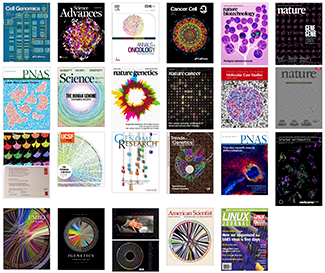
Browse my gallery of cover designs.
Happy 2026 π Day—
Art for the 5%
Celebrate π Day (March 14th) and enjoy the art — but only if you're part of the 5%.
Go ahead, see what you can't see.

Ishihara's Tests for Colour Deficiency
Authentic and accurate images of Ishihara's test plates photographed (and lovingly color-corrected) from the 38-plate Ishihara's Tests for Colour Deficiency.
I also provide the position, size, and color of each circle on each test plate.


Symmetric alternatives to the ordinary least squares regression
What immortal hand or eye, could frame thy fearful symmetry? — William Blake, "The Tyger"
This month, we look at symmetric regression, which, unlike simple linear regression, it is reversible — remaining unaltered when the variables are swapped.
Simple linear regression can summarize the linear relationship between two variables `X` and `Y` — for example, when `Y` is considered the response (dependent) and `X` the predictor (independent) variable.
However, there are times when we are not interested (or able) to distinguish between dependent and independent variables — either because they have the same importance or the same role. This is where symmetric regression can help.

Luca Greco, George Luta, Martin Krzywinski & Naomi Altman (2025) Points of significance: Symmetric alternatives to the ordinary least squares regression. Nat. Methods 22:1610–1612.
Beyond Belief Campaign BRCA Art
Fuelled by philanthropy, findings into the workings of BRCA1 and BRCA2 genes have led to groundbreaking research and lifesaving innovations to care for families facing cancer.
This set of 100 one-of-a-kind prints explore the structure of these genes. Each artwork is unique — if you put them all together, you get the full sequence of the BRCA1 and BRCA2 proteins.
