
Chromosomes
Music, genomes, split-flaps
in such a way as to be understood by everyone,
something that no one ever knew before.
Our goal is to eventually create a full album with a track for each chromosome.
contents
- 1 · Microtonal scales based on chromosome structure
- 1.1 · Cytogenetic bands
- 1.2 · Creating the scales
- 1.3 · Music scale player — explore scales online
- 1.4 · Download the scales
- 1.5 · Choice of chromosomes
- 2 · Creating the music
- 3 · Track 1 — Chromosome 21
- 4 · Track 2 — Chromosome Y
- 5 · Track 3 — Chromosome 1
I wanted to bake in the structure of each chromosome into the tracks. One way to do this was to create a unique scale for each track — a so-called microtonal scale. If we used the cytogenetic banding pattern for each chromosome, we would get such a scale “for free”.
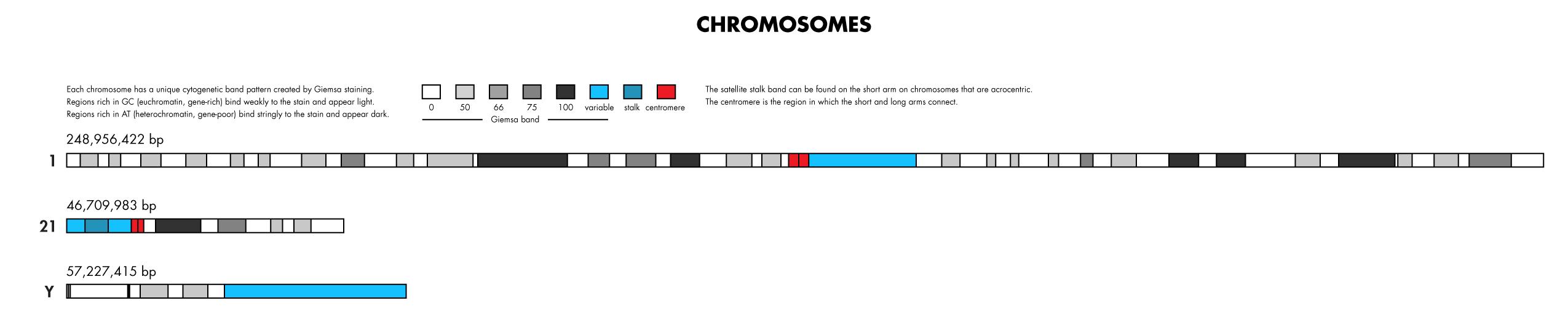
Each chromosome has a unique cytogenetic band pattern created by Giemsa staining.
Regions rich in GC (euchromatin, gene-rich) bind weakly to the stain and appear light.
Regions rich in AT (heterochromatin, gene-poor) bind stringly to the stain and appear dark.
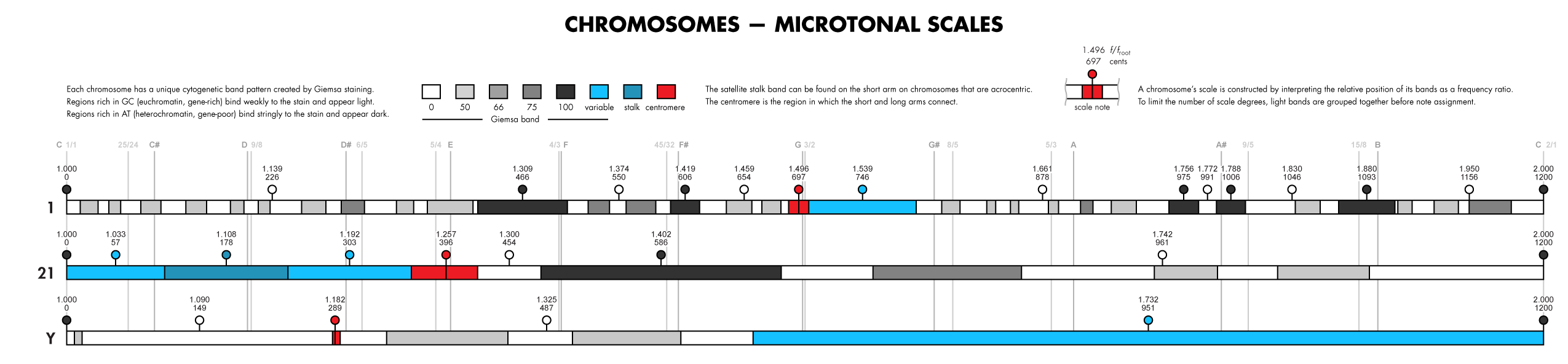
A chromosome’s scale is constructed by interpreting the relative position of its bands as a frequency ratio.
To limit the number of scale degrees, light bands are grouped together before note assignment.
To help Greg experiment with these scales, I created the Music Scale Player — an online tool for exploration of scales of any kind.
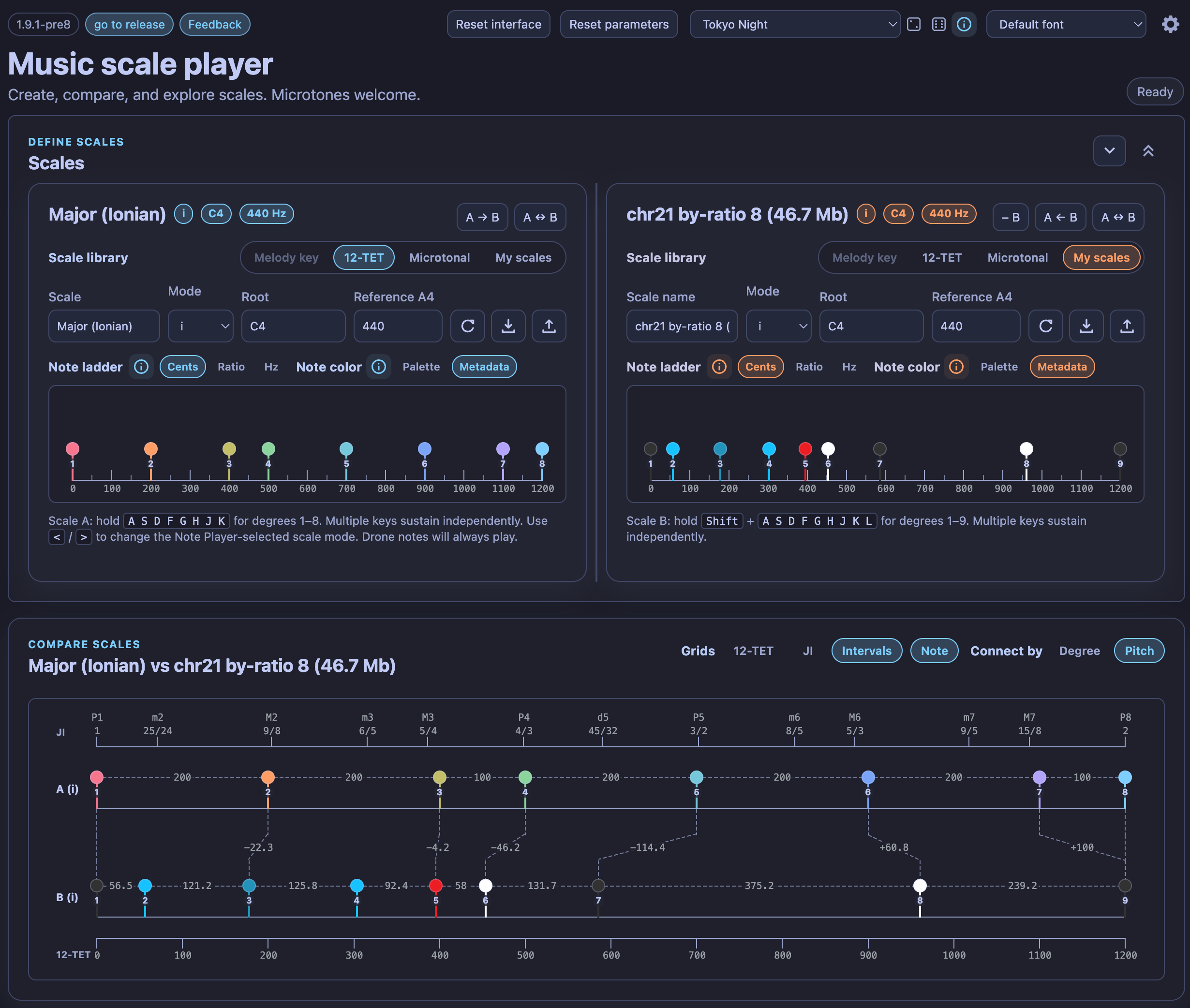
The Music Scale Player makes it easy to compare scales to each other (e.g. our microtonal scales to 12-tone equal temperament scales). You can also use the player to get a feeling for the scales with various musical probes and compose melodic fragments to explore possibilities.
You can download Scala files for all scales.
Each file contains inline comments that provide additional information about each note degree. You may need to remove these before use.
! chr21
!
chr21 by-ratio 8 (46.7 Mb)
8
!
! 1/1 ! @color=323232 @color-playing=fbb03b
56.516 ! 1 1.03 @color=15c2ff @color-playing=fbb03b
177.727 ! 2 1.11 @color=2493ba @color-playing=fbb03b
303.491 ! 3 1.19 @color=15c2ff @color-playing=fbb03b
395.850 ! 4 1.26 @color=ed1c24 @color-playing=fbb03b
453.843 ! 5 1.30 @color=ffffff @color-playing=fbb03b
585.581 ! 6 1.40 @color=323232 @color-playing=fbb03b
960.812 ! 7 1.74 @color=ffffff @color-playing=fbb03b
2/1 ! 8 2.00 @color=323232 @color-playing=fbb03b
In addition to Scala files, the archive contains CSV files that provide the relationship between bands (names, g-stain, positions), and scale degrees.
chr,chr_len,scale_note_degree,scale_note_cents,scale_note_pos,band_start,band_end,band_name,band_stain,band_color
21,46709983,1,0.00,0,,,,,
21,46709983,2,56.52,1550000,0,3100000,p13,gvar,15c2ff
21,46709983,3,177.73,5050000,3100000,7000000,p12,stalk,2493ba
21,46709983,4,303.49,8950000,7000000,10900000,p11.2,gvar,15c2ff
21,46709983,5,395.85,12000000,10900000,12000000,p11.1,acen,ed1c24
21,46709983,5,395.85,12000000,12000000,13000000,q11.1,acen,ed1c24
21,46709983,6,453.84,14000000,13000000,15000000,q11.2,gneg,ffffff
21,46709983,7,585.58,18800000,15000000,22600000,q21.1,gpos100,323232
21,46709983,8,960.81,34654991.5,22600000,25500000,q21.2,gneg,ffffff
21,46709983,8,960.81,34654991.5,25500000,30200000,q21.3,gpos75,828282
21,46709983,8,960.81,34654991.5,30200000,34400000,q22.11,gneg,ffffff
21,46709983,8,960.81,34654991.5,34400000,36400000,q22.12,gpos50,c8c8c8
21,46709983,8,960.81,34654991.5,36400000,38300000,q22.13,gneg,ffffff
21,46709983,8,960.81,34654991.5,38300000,41200000,q22.2,gpos50,c8c8c8
21,46709983,8,960.81,34654991.5,41200000,46709983,q22.3,gneg,ffffff
21,46709983,9,1200.00,46709983,,,,,
The racks themselves were composed in Ableton Live using the Microtuner 2.2 plugin. The plugin maps any scale chromatically onto the piano roll.
After exploring the scales for each chromosome, Greg decided to use chromosomes 1, 21 and Y.
The rationale for these choices was mostly musical. To make the demo less unfamiliar to Western ears, we looked for scales that mapped as closely as possible to the traditional 12-TET tuning.
Greg took these scales and set out to create three short pieces (1–2 mins). Taken together, these would make for a compelling demo.
He began each piece by finding pleasant sounding intervals within the note set. Timbral consideration was very important in choosing the sounds for this project. Instruments or sounds with complex waveforms were too harsh sounding, so simple sounds like sine waves, and instruments like the organ were my preferred choice.
Each chromosome's centromere note was used primarily as a structural component of each composition. Significant musical events in each track were deliberately placed at the location of the centromere.
The ratio bands when translated into time lengths provided a set of rhythms that served as a tool box of given rhythmic patterns that we could draw from.
For example, the organ part in the chromosome 1 track may sound like even 8th notes but, in fact, there are small deviations from the 8th note beat that give the organ part an unusual, broken gait. This rhythm is mirrored in the percussion parts as well.
The rhythms for chromosome Y were derived mostly from the 4:3 ratio between the first and the fourth notes of the scale. This 4 against 3 rhythm is so common in music that it has a name: hemiola. There are 5 organ parts in chromosome Y track — a bassline that moves every 5 beats, the first organ which plays 16ths (beat division into 4) then 12ths (beat div. into 3), then 24ths (beat div. into 6) then finally 32nd notes (beat div into 8). There is a "noise" voice that derived the timing of its frequency changes from the ratio bands of the chromosome translated into a rhythm.
The scale for Chromosome 21 contained notes that were very close to 12-TET notes, including the major and minor 3rd, a diminshed 5th (all very expressive intervals).
As well, other intervals are present, including a minor and major 2nd, and a minor 7th.
The fact that chromosome 21 is responsible for Down's Syndrome, also known as "trisomy 21" (3 copies of chromosome 21), made this chromosome a good choice, as it was likely to be familiar.
! chr21
!
chr21 by-ratio 8 (46.7 Mb)
8
!
! 1/1 ! @color=323232 @color-playing=fbb03b
56.516 ! 1 1.03 @color=15c2ff @color-playing=fbb03b
177.727 ! 2 1.11 @color=2493ba @color-playing=fbb03b
303.491 ! 3 1.19 @color=15c2ff @color-playing=fbb03b
395.850 ! 4 1.26 @color=ed1c24 @color-playing=fbb03b
453.843 ! 5 1.30 @color=ffffff @color-playing=fbb03b
585.581 ! 6 1.40 @color=323232 @color-playing=fbb03b
960.812 ! 7 1.74 @color=ffffff @color-playing=fbb03b
2/1 ! 8 2.00 @color=323232 @color-playing=fbb03b
The tonal centre of this piece is based on the 3rd note of the mode derived from the chromosomal bands. This note is approx 0.4 hz above a D#2 in 12-TET (very close!).
The 3rd note above the D# is very close to an F# or minor third above D#. The 4th note of the scale is about 1/3rd of a semitone flatter than a perfect 5th above D#. Together these three notes make a minor triad (or almost) .
The piece opens with a repeated D# that is 0.4 of a Hz sharp of 12tet. The next note is a perfectly in tune Major 6th. So far our ears are comfortable. But the next two notes stepping up our scale sit outside the 12tet tuning.
    12-TET    our scale
C3  261.6 Hz  261.6 Hz
C#3 277.2 Hz  270.3 Hz
D3  293.7 Hz  289.9 Hz
D#4 311.1 Hz  311.7 Hz
The first two notes and the last note are "in tune" while the 3rd and 4th notes are "out of tune", giving us a balance of the familiar and unfamiliar.
A similar principle is used to generate the notes for the other plucked parts that we hear at:8.5secs, 15 secs and 32.5 secs.
The melody heard at 14.5 secs exploits the expressive utility of the semitone.
At 16.3 seconds the bass and drums enter, marking the position of the centromere which occurs at 26% of the length of the piece which is 1min and 3 seconds.
The bassline starts on D#1 - 77.9hz. This is 0.1 of a hz above the 12tet tuning. From there the notes are below are the 12tet tuning and our tuning.
    12-TET    our scale
E0  41.1 Hz   41.2 Hz
D#0 38.9 Hz   39.0 Hz
F0  43.6 Hz   42.5 Hz
Only the F0 is significantly out of tune.
At 47 seconds we hear in the right channel a rising Shepard tone built from the eight notes of our scale.
The rhythmic structure of this piece is driven by musical considerations such as a simple techno "four on the floor" drum beat.
The scale for chromosome Y contained only 5 notes, 2 of which were close to the minor 3rd and perfect 4th of the 12-TET scale. The other two were more distant but were useful in that they were halfway between a minor and major second, and a major 6th and minor 7th.
! chr24
!
chr24 by-ratio 5 (57.2 Mb)
5
!
! 1/1 ! @color=323232 @color-playing=fbb03b
149.181 ! 1 1.09 @color=ffffff @color-playing=fbb03b
289.082 ! 2 1.18 @color=ed1c24 @color-playing=fbb03b
487.216 ! 3 1.33 @color=ffffff @color-playing=fbb03b
951.333 ! 4 1.73 @color=15c2ff @color-playing=fbb03b
2/1 ! 5 2.00 @color=323232 @color-playing=fbb03b
This piece is built around the sound of a church organ. The relatively simple nature of the sound wave means that there are fewer dissonant overtones so the music will remain more harmonious that it would otherwise.
The scale for chr24 is simple - only 5 notes. The third note of the scale is very close to a D# (a minor 3rd above C)and the 4th note is very close to F (a perfect 4th above C) The fifth note of the scale is halfway between A and A#.
The tonal centre of this piece is built on the second degree of the scale C#. The bassline alternates between C#0 (35.6Hz) and D#0 (38.7Hz) The standard tuning for these two notes are 34.6Hz and 38.7Hz. You can see that the D# is in tune, while the C# is approx 1 Hz above standard tuning. Despite this the C# still feels strongly like our root note.
The centromere occurs at 18% of the length of the chromosome and this is marked by a low howling sound at approx 19 secs. The piece is 108 seconds long.
The rhythmic concept of this piece is built around the ratio of 4:3 which is found within the scale between the 1st and 4th notes. The ratio isn't perfect but it's so musically compelling (and familiar) that I decided to roll with it. There are 4 organ arpeggios that have staggered entries : 6sec, 30sec, 54sec and 1min 18 secs. The first arpeggio is played in 16th notes (div of 4), the second arpeggio is played in 12ths (div of 3) the third arpeggio is played in 24ths (div of 6) and the final arpeggio is played in 32nd notes (div of 8)
The first three arpeggios make use of only 2 pitches - C# and A# - in various octaves. The 4th arpeggio plays the scale in sequence from low to high and back again - this introduces the most dissonance at the climax of the piece.
The rhythmic elements of this piece also reflect this 4:3 ratio which when applied to a rhythm is called a hemiola. At 30 seconds, along with teh entry of the second organ arpeggio, we hear a shaker played in a 3/4 rhythm. The time signature for this piece is 5/4, so this creates a beat cycle of 15 beats. Simultaneously at 30 seconds we hear a rhythmic figure in 4/4. This creates a beat cycle of 20 beats. At 54 seconds, along with the 3rd organ arpeggio we hear a kick drum pattern which plays a repeating 5 beat pattern, as well as another rhythmic figure in 4/4, that also creates a 20 beat cycle. To increase the tension as we build towards the climax, a syncopated snare drum pattern enters and becomes increasingly dense. Each of the rhythmic entries are supported by reversed sounds that build to the entry of the new sound.
The final thing to say about the rhythm of this chromosome is the noise track. This track uses white noise played at different frequencies. The timing of the frequency changes are determined by the ratio of the chromosomal bands translated into lengths of time.
Chromosome 1 was an obvious place to start as it contains an almost perfect 5th. The 5th is a strong harmonic sound, due to its early place in the harmonic series, and it also plays a significant role in Western music theory.
This chromosome also contains other notes that are close to notes from the equal tempered scale including a major 2nd, perfect 4th, diminished 5th, major 6th, minor 7th, and a major 7th.
The close proximity of these notes to 12-TET notes, allowed us to control the degree to which the music departed from Western music.
! chr01
!
chr01 by-ratio 15 (249.0 Mb)
15
!
! 1/1 ! @color=323232 @color-playing=fbb03b
225.596 ! 1 1.14 @color=ffffff @color-playing=fbb03b
465.746 ! 2 1.31 @color=323232 @color-playing=fbb03b
550.009 ! 3 1.37 @color=ffffff @color-playing=fbb03b
605.542 ! 4 1.42 @color=323232 @color-playing=fbb03b
653.637 ! 5 1.46 @color=ffffff @color-playing=fbb03b
696.949 ! 6 1.50 @color=ed1c24 @color-playing=fbb03b
746.222 ! 7 1.54 @color=15c2ff @color-playing=fbb03b
878.210 ! 8 1.66 @color=ffffff @color-playing=fbb03b
975.104 ! 9 1.76 @color=323232 @color-playing=fbb03b
990.869 ! 10 1.77 @color=ffffff @color-playing=fbb03b
1006.297 ! 11 1.79 @color=323232 @color-playing=fbb03b
1045.894 ! 12 1.83 @color=ffffff @color-playing=fbb03b
1093.132 ! 13 1.88 @color=323232 @color-playing=fbb03b
1155.882 ! 14 1.95 @color=ffffff @color-playing=fbb03b
2/1 ! 15 2.00 @color=323232 @color-playing=fbb03b
The opening notes are F and C (a perfect 5th apart) the chord is then added to with a Bb (P5th below F) and octave Cs.
At 15 secs there is a Bb that is pitch bent up to a C and back.
At 47.5 seconds, exactly half way into the piece, the position of the centromere is marked by the introduction of the bass drum - the first rhythmic element of the piece.
The rhythm of the bass drum is drawn from the GPT analysis. All the rhythms used in the percussion section are derived from this single rhythm taken from the first closed hi hat pattern which is a 9:8 poly rhythm.
The bass drum excludes four of the notes of the original pattern to create a five note pattern that is heard across 4 beats.
The full hihat pattern is then used to generate the other percussion parts as they enter, e.g the hi tom drum heard in the right channel @52secs is a rhythmic diminution at twice the original speed - this creates an 18:16 polyrhythm.
At 1.23 the percussion outline, in near rhythmic unison, a rhythm that is derived from the original rhythm, but with the 1st, 4th and 7-9th notes halved. This creates the driving energy with which the piece ends.
The organ part which commences at 58.5secs into the piece also derives its rhythm from the GPT closed hihat 18:16 poly rhythm. This ensures rhythmic coherence between the parts. Each of the 18 notes of the pattern are articulated by the four organs as they enter successively.
The pitch set is starts very low at 32.7Hz (C1), which as a pure tone would barely be audible, but because the the organ sample includes higher overtones the note is clearly audible.
After that the following notes are heard in succession:
 48.9 Hz: G1
 97.2 Hz: G2
130.7 Hz: C3
195.7 Hz: G3
234.1 Hz: (slightly sharp Bb3)
261.7 Hz: C4 (Middle C)
391.6 Hz: G4