Chromosomes
Music, genomes, split-flaps
in such a way as to be understood by everyone,
something that no one ever knew before.
Our goal is to eventually create a full album with a track for each chromosome.
contents
In 2022, together with Gregory Coles, we composed a piano album (three one four — a number of notes) to celebrate 2022 `\pi` day.
For the 2023 `\pi` day, Greg and I collaborated again, along with the vocalist from Flunk to create a 10 hour recording of 10,000 digits of `\pi`, read out in various languages.
So, when the American Museum of Natural History reached out to me to be part of a colloqium to discuss the next Invisible Worlds exhibit with DNA as a the central theme, I thought Greg and I should work again to create a short demo of what a music album about DNA might sound like.
We created “Chromosomes”, a 6 minute demo, composed of 3 tracks based on the structures of chromosomes 1, 21, and Y. On these pages, I describe the methods and process that went into the creation of the demo.
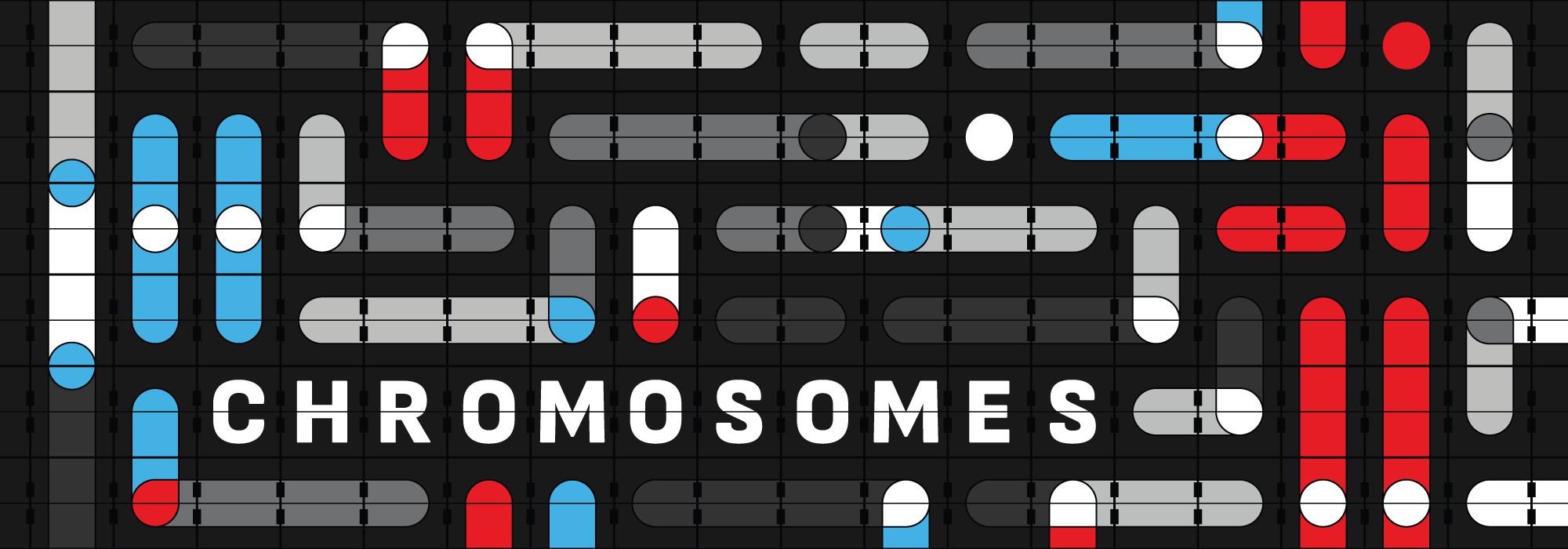
The cover design and ideogram elements were suggested by John Dupuis. They add a playful aspect to the split-flap panel — watch them grow and divide.
Music was composed by Gregory Coles. For detailed description of the composition, check out Greg's composer notes in the Methods section.
Each track is based on a unique microtonal scale derived from the structure of human chromosomes 1, 21, and Y.
“Microtonal, you say?”
Don't worry, it will sound great.
Briefly, a chromosome’s scale is constructed by interpreting the relative position of its bands as a frequency ratio. To limit the number of scale degrees, light bands are grouped together before note assignment.
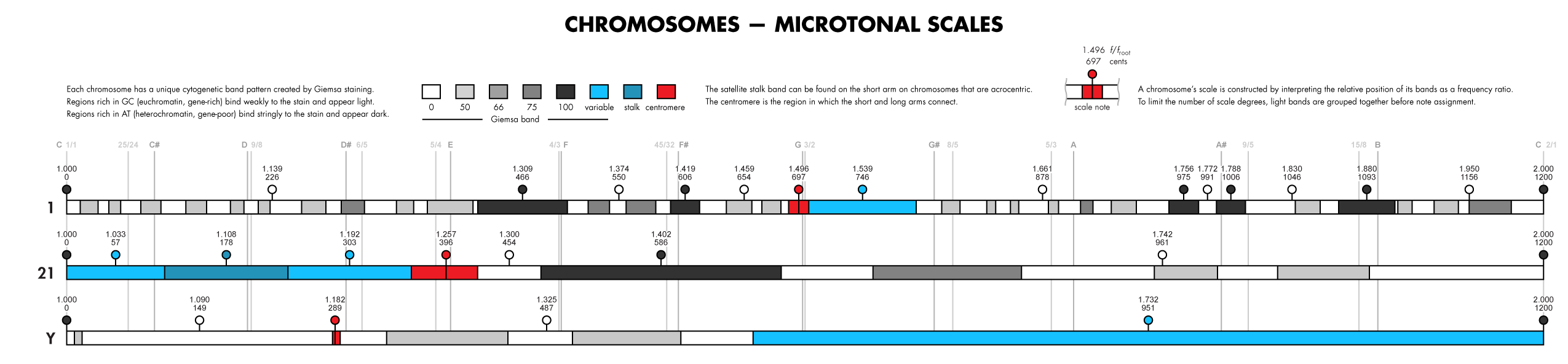
There's more detail about this in the Methods section.
Track 1 starts by initializing the split-flap panel and opens with pleasant sounds hint at clockwork computation.
All in all, a pleasant way to begin.
Track 2 has a much darker tone, with ancestral vibes and hints at the unknown.
Thanks chromosome Y!
This track wraps things up with a glitchy climax. We hear someone telling us of “unknown effects” and “endless possibilities”.
It wouldn't be an ending without a 2 minute reverb tail.
The voice recording is by Hannah Iqbal.
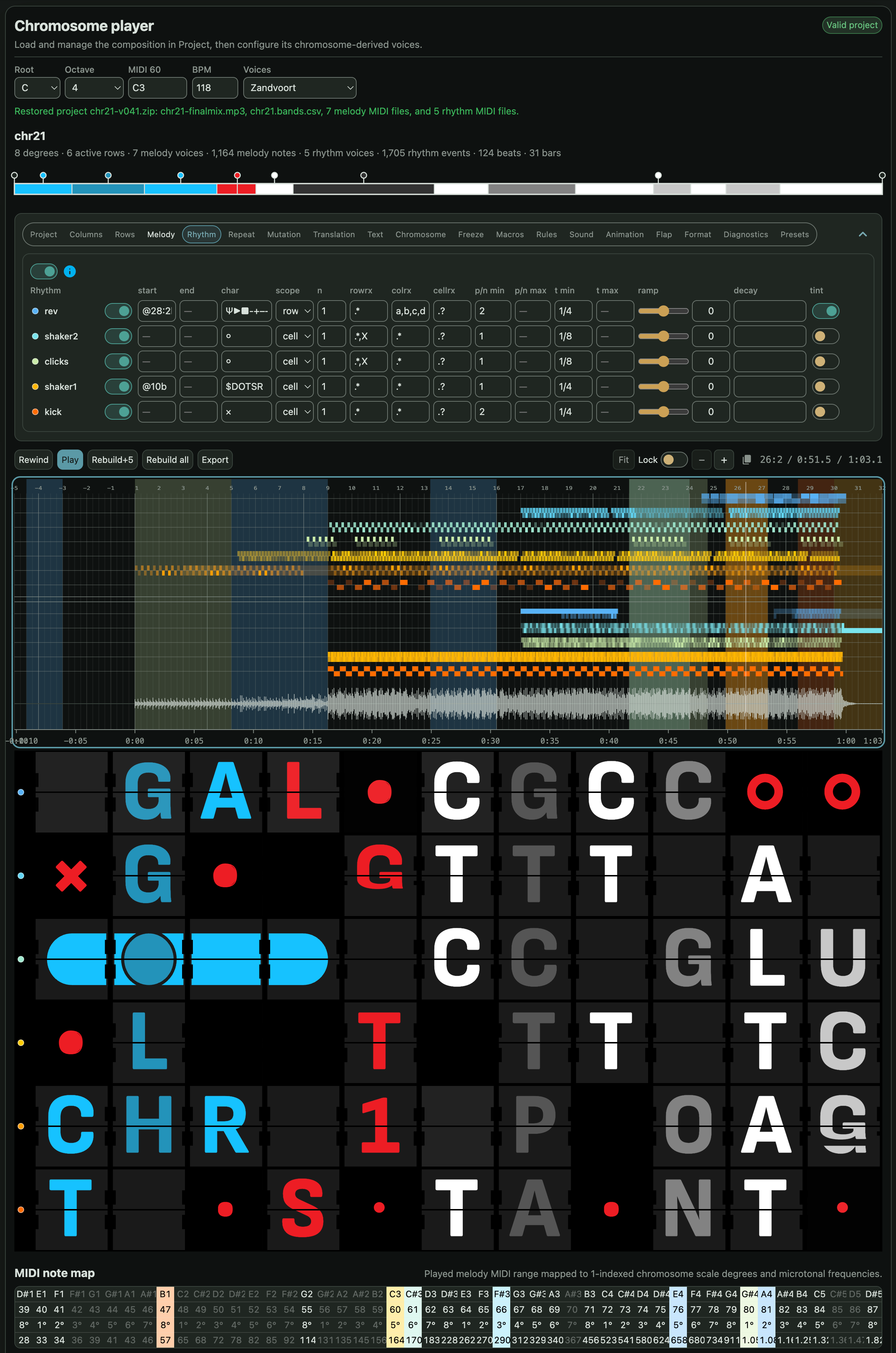
For the animation, I created a web-based system that provided a framework for split-flap animation.
It began with a relatively simple idea to map MIDI events exported from Ableton onto onto events in the split-flap panel.
The system quickly grew to support mutations, repeats, translation, and dividing ideograms. Making it almost killed me — but don't worry, I am now stronger for it.