
Beyond Belief Campaign BRCA Artwork
A one-of-a-kind way of saying thank you
Art is science in love.
— E.F. Weisslitz
In collaboration with the BC Cancer Foundation, I created a set of 100 one-of-a-kind artworks gifted to Board Members and volunteers of the Beyond Belief Campaign in recognition of their efforts and contributions.
The Beyond Belief Campaign was launched in 2022 and has raised nearly $500 million for cancer research.
Our artwork takes a new twist on the BRCA1 and BRCA2 genes. What makes each piece different? Read below to discover.


contents
BC Cancer’s mandate covers the full spectrum of cancer care from prevention, screening, diagnosis and treatment, to research and education, to supportive and palliative care.
The Beyond Belief Campaign has raised nearly $500 million for cancer research.

Activate World-Class Experts
Empower BC Cancer’s world-class experts across the province to help them unleash their full potential.
Create cutting-edge research opportunities to attract and retain top talent at BC Cancer.
Train and develop the next generation of scientists and clinicians.
Supply the necessary resources and tools for BC Cancer experts to conduct life-saving research.
Advance
Innovation
BC Cancer has a history of innovations that fast become the standard of care around the world.
Pioneer cutting-edge treatments with state-of-the-art facilities, research and clinical trials.
Revolutionize how cancer is treated by advancing new precision treatments.
Enable early detection and screening with enhanced techniques.
Accelerate Access
to Care
Bring world-class cancer care closer to home for every British Columbian.
Equip existing and new BC Cancer centres with state-of-the-art technologies for diagnostics, treatment and early detection.
Expand BC Cancer’s provincial clinical trials network to provide patients access to the cutting-edge treatments, no matter where they live.
Enhance supportive care services to support the physical, mental and emotional well-being of patients and families.

source: BC Cancer Foundation
Since 2016, the Familial Pancreatic Cancer Program supported over 1,200 people with pancreatic cancer – 9.5% of those who completed genetic testing had an inherited susceptibility gene that, for some patients, enabled the use of specific types of chemotherapy that are more effective in people with BRCA mutations.
In 2023, a pilot project was launched to offer genetic testing for all breast cancer patients under 60 to identify genetic mutations that increase cancer risk, including the BRCA mutation – so far, two out of thirty patients who underwent testing were identified as carrying mutations and are now being supported by the Hereditary Cancer Program.
In 2024, a first-in-Canada initiative was launched to directly contact relatives of high-risk individuals to pursue genetic testing, including for the BCRA gene mutations. As of mid-2025, 55 at-risk families have been identified as eligible to undergo Parent-of-Origin-Aware genomic analysis.

BRCA1 and BRCA2 genes are so-called tumor suppressor genes, also known as anti-oncogenes. Genes of this type regulate the cell during division and guard against uncontrollable division of cells.
The proteins of both BRCA1 and BRCA2 are normally expressed in the cells of breast and other tissues, where they help repair damaged DNA, or destroy cells if DNA cannot be repaired.
Mutations in these genes create dysfunctional proteins. This puts people at a higher risk of developing breast, ovarian, pancreatic, prostate and other types of cancer.
The fundraising campaign could not happen without tireless support from volunteers. Our aim was to create artwork that could say not only "thank you" but speak to the team work and effort required for scientific advance.
The artwork depicts The discovery and insight gained into the function of these two genes (among others) have led to world leading advancements in care for breast, prostate, ovarian, pancreatic cancer patients at BC Cancer.
Below, I place the artwork in context of the genome and walk you through the elements on it.
For technical details about how the artwork was constructed, see the Methods section.
The BRCA1 and BRCA2 genes are on chromosomes 17 and 13, respectively. In the figure below, I show all the human chromosomes and call out the positions of these genes.
Relative to the chromosomes, the genes are very tiny. For example, chromosome 17 is about 83,000,000 bases long but the genomic region that corresponds to the BRCA1 gene is only about 81,000 bases — 1/1000th the length of the chromosome.
Relative to other genes, BRCA1 and BRCA2 are longer than the median, which is about 24,000 bases.

If we zoom in on the view above by a factor of 4,000×, the structure of the BRCA1 and BRCA2 genes is revealed.
Most of the genes are composed of introns, which are regions of the sequence that do not participate in the protein sequence.
A small fraction of the gene region is made up on exons, most of which code for protein, meaning that their genomic sequence encodes the amino acid sequence of the protein. A few of exons are non-coding.

The artwork is based on the genomic regions of BRCA1 and BRCA2, with a focus on protein sequence. However, because most of the genes are introns, I've decided to depict the genes with the introns compressed. This makes more room for the exons — and annotating the art with protein sequence.
With the introns compressed, the relative lengths of the genes is closer to the relative lengths of their proteins. The length of the wild-type BRCA1 and BRCA2 proteins is 1,863 and 3,418 amino acids, respectively.

Now that you have a rough sense of the structure and relative length of the genes, let's look at how we might draw their structure in the figure above in a way that is both more interesting to the eye but that also adds another layer of information.
The genes on the artwork are drawn as a path, which is shared by all the 100 artworks. This path is shown below.

The compression factor for non-coding exons and introns is a little different here than in the expanded linear view. There's nothing particularly special about this change of scale — I've selected it to create paths that had an intersting shape and snugly fit onto a square canvas.
You will notice that the path curves in some regions more than in others. This curvature is determined by the entropy of the genomic sequence.
In this context, entropy refers to the level of information (or uncertainty). The path is straighter in regions with low entropy (or information). These are regions of the gene that have more repeat content (e.g. ATATAT). The path is curvier in regions of high information, where there is less repetition in the sequence.
For more information about entropy, see the Methods section.
Now that you know what the backbone of each artwork is, it's time to turn to what makes each of the 100 versions unique.
As I mentioned, the wild-type protein sequences of BRCA1 and BRCA2 are composed of 1,863 and 3,418 amino acids, respectively. Each artwork labels the positions of a subset of these amino acids — about 19 on BRCA1 and 34 on BRCA2.
This set of amino acids is different for each artwork. Moreover, any given amino acid appears in only one artwork. Technically, these sets represent a partitioning of the sequence.
Any one artwork does not tell you the whole story but the entire set does. If you looked at each artwork carefully (you'd have to look at them all), you could work out the protein sequence of the two genes.
In addition, each artwork shows a mutation on each gene. This mutation was selected from ClinVar as being somatic, pathogenic, single nucleotide variant and reviewed by an expert panel.
The mutation is either nonsense (one amino acid is mutated into another) or terminating (the protein is truncated at the position of the mutation). Across the 100 artworks, 100 different BRCA1 and 100 different BRCA2 mutations are shown.

Each artwork comes with an interpretive plaque that describes what is shown and shows the position of the amino acids and mutations along the full length of the protein.

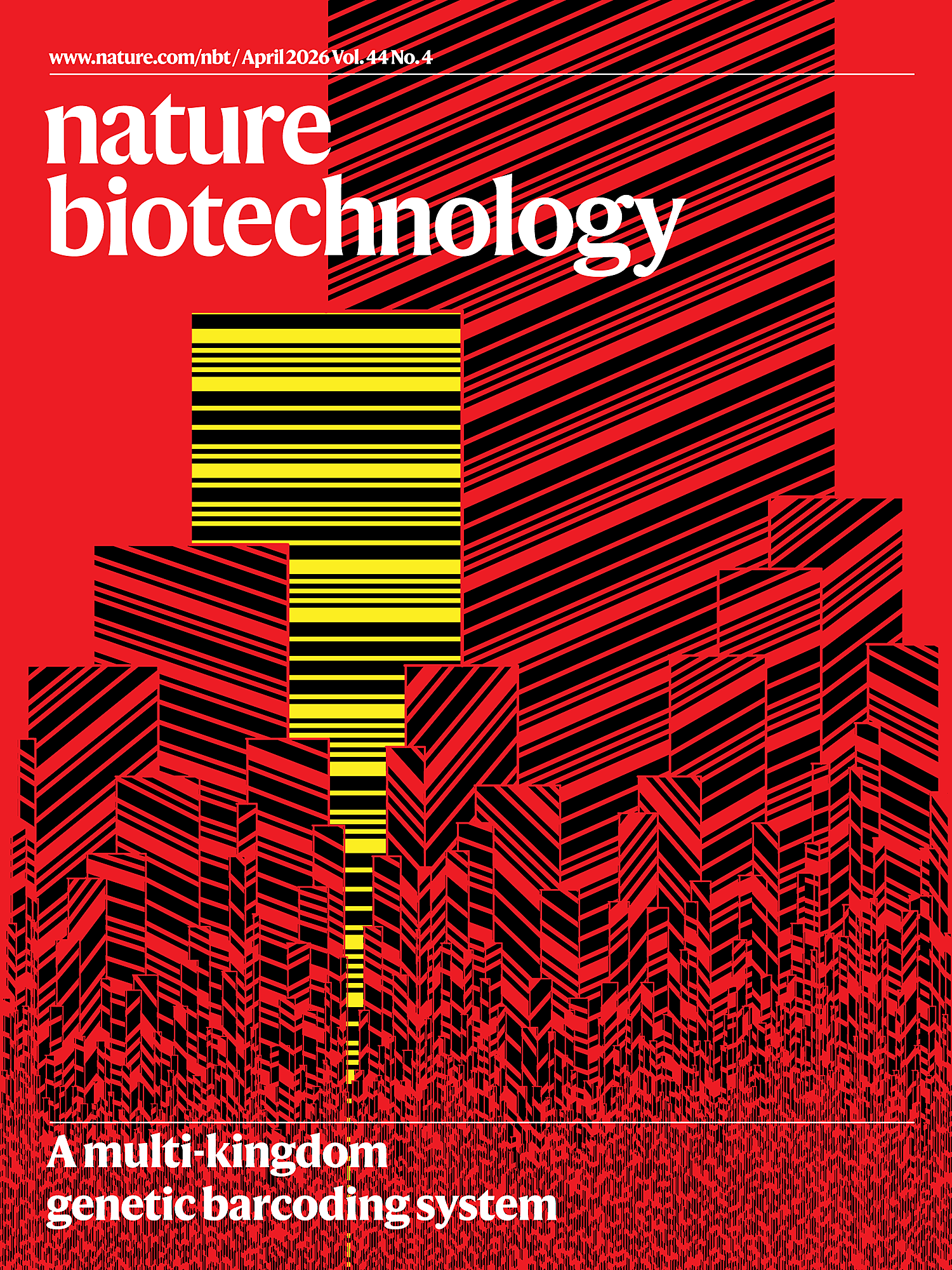
Nature Biotechnology cover
My cover design on the 7 April 2026 Nature Biotechnology issue shows the dendrogram that represents a cluster of uniquely expressed (or downregulated) genes in human naive stem cells induced from such cells. Within each dendrogram block, the genomic barcode sequence (sampled from Supplementary Table 1) is depicted with a Code 39 barcode. The highlighted barcode is one of those used for cell isolation.
Ishiguro S. et al. A multi-kingdom genetic barcoding system for precise clone isolation (2026) Nature Biotechnology 44:616–629.
Browse my gallery of cover designs.
Happy 2026 π Day—
Art for the 5%
Celebrate π Day (March 14th) and enjoy the art — but only if you're part of the 5%.
Go ahead, see what you can't see.

Ishihara's Tests for Colour Deficiency
Authentic and accurate images of Ishihara's test plates photographed (and lovingly color-corrected) from the 38-plate Ishihara's Tests for Colour Deficiency.
I also provide the position, size, and color of each circle on each test plate.


Symmetric alternatives to the ordinary least squares regression
What immortal hand or eye, could frame thy fearful symmetry? — William Blake, "The Tyger"
This month, we look at symmetric regression, which, unlike simple linear regression, it is reversible — remaining unaltered when the variables are swapped.
Simple linear regression can summarize the linear relationship between two variables `X` and `Y` — for example, when `Y` is considered the response (dependent) and `X` the predictor (independent) variable.
However, there are times when we are not interested (or able) to distinguish between dependent and independent variables — either because they have the same importance or the same role. This is where symmetric regression can help.

Luca Greco, George Luta, Martin Krzywinski & Naomi Altman (2025) Points of significance: Symmetric alternatives to the ordinary least squares regression. Nat. Methods 22:1610–1612.
Beyond Belief Campaign BRCA Art
Fuelled by philanthropy, findings into the workings of BRCA1 and BRCA2 genes have led to groundbreaking research and lifesaving innovations to care for families facing cancer.
This set of 100 one-of-a-kind prints explore the structure of these genes. Each artwork is unique — if you put them all together, you get the full sequence of the BRCA1 and BRCA2 proteins.

Propensity score weighting
The needs of the many outweigh the needs of the few. —Mr. Spock (Star Trek II)
This month, we explore a related and powerful technique to address bias: propensity score weighting (PSW), which applies weights to each subject instead of matching (or discarding) them.
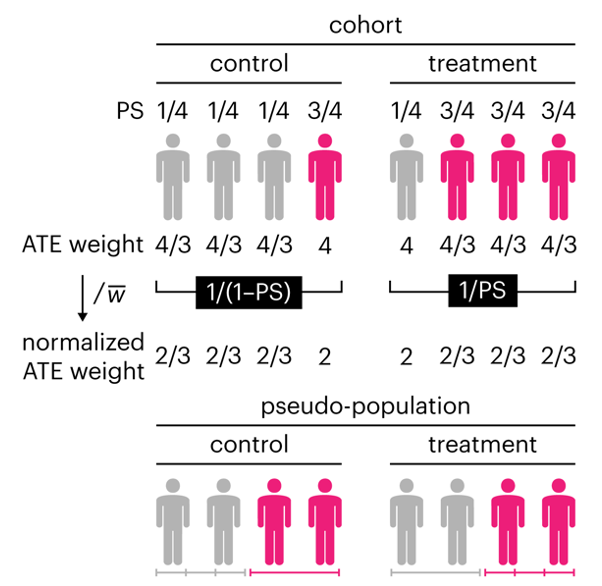
Kurz, C.F., Krzywinski, M. & Altman, N. (2025) Points of significance: Propensity score weighting. Nat. Methods 22:638–640.