
Infinity with Max Cooper — In Six Minutes
To Infinity and beyond!
—Buzz Lightyear
contents
In collaboration with Max Cooper, we tell a story about infinity in 6 minutes (and 34 seconds).
What's the story about? Natural numbers, integers, rationals, reals, power sets and the cardinality of the continuum — a real visual parade of numbers.
But math is a serious matter — so we include two of Cantor's diagnoal proofs in the video. Watch as we show that the size of the set of rational numbers is the same as the set of natural numbers (making them countable) but that the size of the set of real numbers is larger (making them uncountable).
In science one tries to tell people,
in such a way as to be understood by everyone,
something that no one ever knew before.
But in poetry, it’s the exact opposite.
—Paul Dirac, Mathematical Circles Adieu by H. Eves [quoted]
The style of Aleph 2 is that of a low-fi terminal. We used the Classic Console font by Csaba Széll, which I extended to include more set theory symbols (download extended font).
The animation was closely synchronized to the music, all the while trying to avoid looking too much like something from the Matrix movie.
To help you interpret what you are seeing, I walk you through the video and introduce you some advanced concepts of set theory. This way, next time you see an equation like `|\mathbb{R}| = | \mathbb{P}(\mathbb{N}) | = 2^{\aleph_0}`, you'll sprout a smile of joy.


These pages describe the system I build to generate the animation and the mathematics behind infinity, including sets, cardinality, countability, $\aleph$ and the Continuum Hypothesis.
I also present the animation system I built for the video, which was coded from scratch.
If you like infinity, you might like dimensions too.
Check out my video for Max Cooper's Ascent, which animates 5-dimensional cubes doing their confusing things.
Happy 2026 π Day—
Art for the 5%
Celebrate π Day (March 14th) and enjoy the art — but only if you're part of the 5%.
Go ahead, see what you can't see.

Ishihara's Tests for Colour Deficiency
Authentic and accurate images of Ishihara's test plates photographed (and lovingly color-corrected) from the 38-plate Ishihara's Tests for Colour Deficiency.
I also provide the position, size, and color of each circle on each test plate.


Symmetric alternatives to the ordinary least squares regression
What immortal hand or eye, could frame thy fearful symmetry? — William Blake, "The Tyger"
This month, we look at symmetric regression, which, unlike simple linear regression, it is reversible — remaining unaltered when the variables are swapped.
Simple linear regression can summarize the linear relationship between two variables `X` and `Y` — for example, when `Y` is considered the response (dependent) and `X` the predictor (independent) variable.
However, there are times when we are not interested (or able) to distinguish between dependent and independent variables — either because they have the same importance or the same role. This is where symmetric regression can help.

Luca Greco, George Luta, Martin Krzywinski & Naomi Altman (2025) Points of significance: Symmetric alternatives to the ordinary least squares regression. Nat. Methods 22:1610–1612.
Beyond Belief Campaign BRCA Art
Fuelled by philanthropy, findings into the workings of BRCA1 and BRCA2 genes have led to groundbreaking research and lifesaving innovations to care for families facing cancer.
This set of 100 one-of-a-kind prints explore the structure of these genes. Each artwork is unique — if you put them all together, you get the full sequence of the BRCA1 and BRCA2 proteins.

Propensity score weighting
The needs of the many outweigh the needs of the few. —Mr. Spock (Star Trek II)
This month, we explore a related and powerful technique to address bias: propensity score weighting (PSW), which applies weights to each subject instead of matching (or discarding) them.
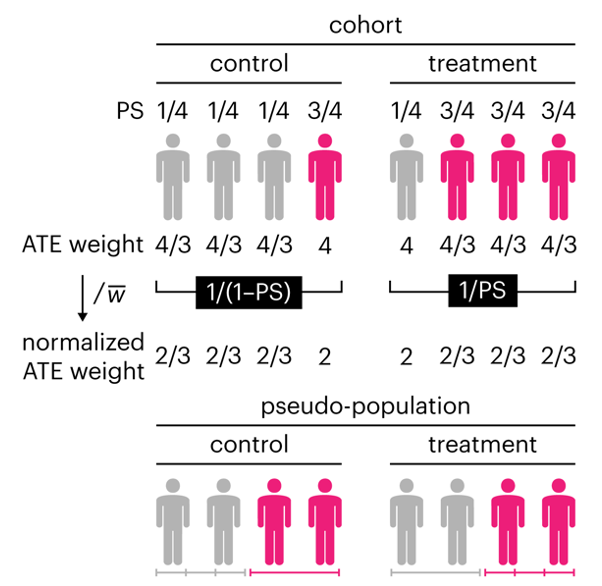
Kurz, C.F., Krzywinski, M. & Altman, N. (2025) Points of significance: Propensity score weighting. Nat. Methods 22:638–640.
Happy 2025 π Day—
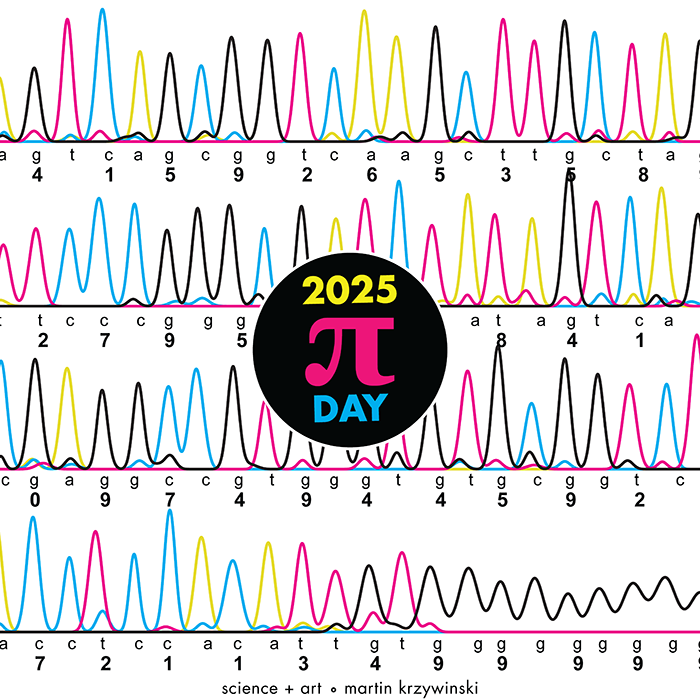
TTCAGT: a sequence of digits
Celebrate π Day (March 14th) and sequence digits like its 1999. Let's call some peaks.